Booking choice: The guided Citadel walk, from $47 per person. Check dates Tour details
The Citadel is the reason Amman exists where it does. A defensible hilltop above a valley with a spring, the Ras al-Ain, was too good a spot to leave empty, and the Department of Antiquities lists remains from the Bronze Age, the Iron Age, the Roman, the Byzantine and the Islamic periods. Excavations found settlement running from the Bronze Age through the late Islamic centuries.
This guide runs through the periods in order. Where scholars disagree, or where a popular claim does not hold up, we say so. The sources are the DoA, the American Center of Research, the University of Münster's current excavation and standard references.
The quick answer
People have lived on the hill since at least the Bronze Age; it was walled around 1800 BCE. In the Iron Age it was Rabbath Ammon, capital of the Ammonites. Ptolemy II renamed the city Philadelphia in the 3rd century BC, and under Rome it joined the Decapolis and got its great temple (AD 161-166). Byzantine churches followed, then the Umayyad governor's palace in the 8th century, wrecked by an earthquake in 749. The hill was largely deserted until Circassian settlers arrived in 1878.
What is the Amman Citadel?
An L-shaped hill in central Amman, Jabal al-Qal'a, about 850 m above sea level, with walls about 1,700 m long and remains from the Bronze Age to the Ayyubid era.
Amman grew up on seven hills, its jebels, and this was the first to be fortified. The hill's natural shape, a steep-sided L with flat tops, made it the obvious place for a capital's palace and temple, and later for a governor's residence. Its name simply means "hill of the citadel".
The Citadel is not a single building but a stack of them. The walls were rebuilt in the Bronze and Iron Ages and in the Roman, Byzantine and Umayyad periods, and every builder quarried the ruins of the last. You see it everywhere: Roman capitals in a Byzantine church, temple drums in a medieval tower.
| Period | Dates | On the hill |
|---|---|---|
| Bronze Age | Walled c. 1800 BCE | First fortifications, a Middle Bronze Age tomb |
| Iron Age (Ammonite) | After c. 1200 BCE to 6th century BCE | Rabbath Ammon: palace, temple, inscriptions |
| Hellenistic | 3rd century BC | Renamed Philadelphia by Ptolemy II |
| Roman | 1st century BC to 4th century AD | Decapolis city; Temple of Hercules, AD 161-166 |
| Byzantine | 4th to 7th century | Three churches; basilica c. AD 550 |
| Umayyad | 661 to 750 | Governor's palace, mosque, cistern; earthquake of 749 |
| Abbasid to Ayyubid | 750 to 13th century | Decline; watchtower c. 1220 |
| Modern | 1878 onwards | Circassian settlers; museum in the early 1950s |
Is Amman the oldest city in the world?
No, but it is one of the oldest settled places. 'Ain Ghazal, in north-east Amman, was a large Neolithic village from about 7000 to 5000 BC. Amman was not continuously inhabited, so "oldest city" claims don't hold.
The deep history is at 'Ain Ghazal, discovered in 1974 during road building on the city's north-eastern edge. At its peak it covered 10 to 15 hectares and housed about 3,000 people, one of the largest settlements of its time anywhere. Its famous plaster statues, made around 7200 to 6250 BC (the Smithsonian puts them at about 6500 BC), are among the oldest large human figures ever found. Most are in The Jordan Museum today, and some remain in the Citadel museum.
You will read that the Citadel is "one of the oldest continuously inhabited places in the world". It isn't. After the Abbasid period the old city declined, and by the 15th century it was a field of ruins used by Bedouin and seasonal farmers. Earthquakes, environmental decline and malaria in the river valley all played a part. Permanent settlement only returned in 1878, when the Ottomans settled Circassian refugees here. Modern Amman grew from that village, became the capital of the Emirate of Transjordan in 1921, and now holds about 5 million people.
The defensible line is this: Amman has been settled since the 8th millennium BC, and the Citadel since at least the Bronze Age, with long gaps. Neolithic remains on the Citadel hill itself are weakly attested; the Neolithic story belongs to 'Ain Ghazal.
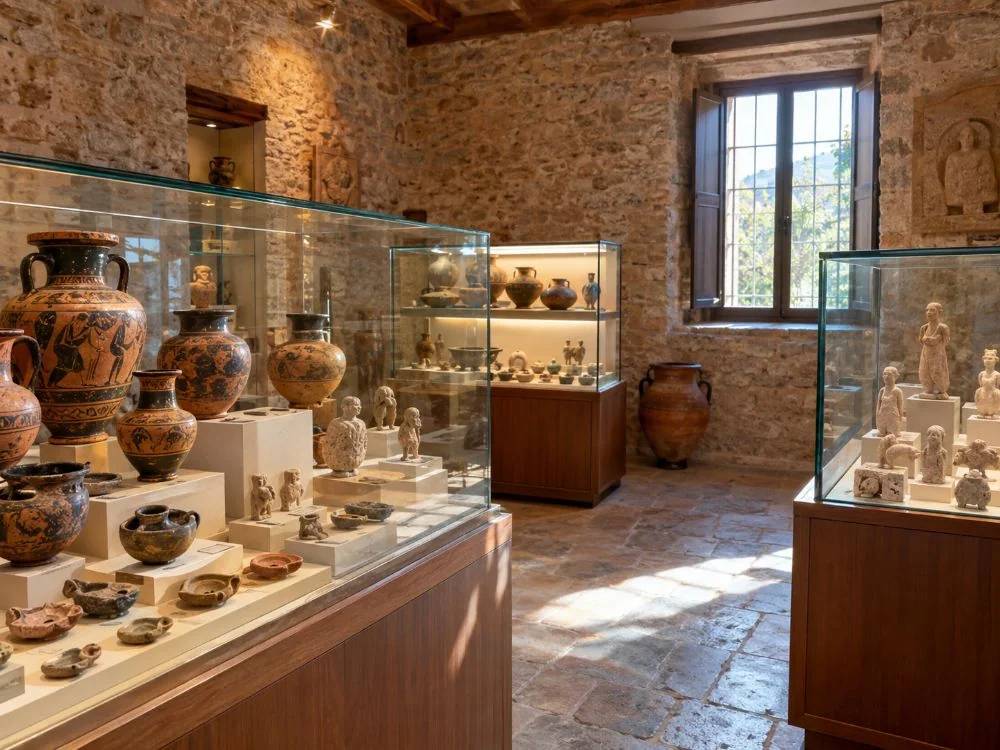
Who were the Ammonites, and what was Rabbath Ammon?
An Iron Age people whose kingdom was centred on this hill. Their capital, Rabbath Ammon, is the Rabbah of the Hebrew Bible; Amman still carries the name.
The hill was fortified in the Bronze Age, around 1800 BCE, and a Middle Bronze Age tomb on the slope held pottery and scarab seals. After about 1200 BCE it became the seat of the kingdom of Ammon, and the DoA describes the Iron Age hill as a centre of governance with a palace and a temple. The Amman Citadel Inscription, carved in a Phoenician-type alphabet, is the oldest known Ammonite text.
The Hebrew Bible calls the city Rabbah or Rabbat Bene Ammon, and it describes David's army besieging it. In the 8th century BCE Ammon became a vassal of Assyria under Tiglath-Pileser III, and later passed under Babylonian and Persian rule. An ASOR overview from March 2026 dates the main Iron Age II phase on the Citadel to about 900 to 600 BCE.
New finds are still coming. Since 2024 the University of Münster and the German Archaeological Institute, with the DoA, have been excavating a monumental Iron Age building on the Lower Terrace, possibly an Ammonite royal palace, dated broadly to the 10th to 7th centuries BCE. Their seasons in 2024, 2025 and June 2026 turned up double-faced female heads and ivory inlays.
See the hill with someone who can read it: a guided walk around the Citadel.
Check dates for the guided Citadel walkWhy was Amman called Philadelphia?
Ptolemy II Philadelphus, the Greek ruler of Egypt, rebuilt the city in the 3rd century BC and renamed it after himself. The name lasted through the Roman and Byzantine centuries.
After Alexander's empire split, this region was fought over by the Ptolemies of Egypt and the Seleucids of Syria. Ptolemy II rebuilt Rabbath Ammon and gave it his epithet, Philadelphia, "brotherly love" (Britannica). Few Hellenistic buildings survive on the hill, but pottery shows the site stayed occupied.
Rome arrived in the 1st century BC, and Philadelphia became one of the Decapolis, the league of Greek-speaking cities east of the Jordan that included Jerash and Gadara (Umm Qais). In AD 106 the region became part of the Roman province of Arabia. The city spread into the valley, and the hill became its acropolis.
What did the Romans build on the Citadel?
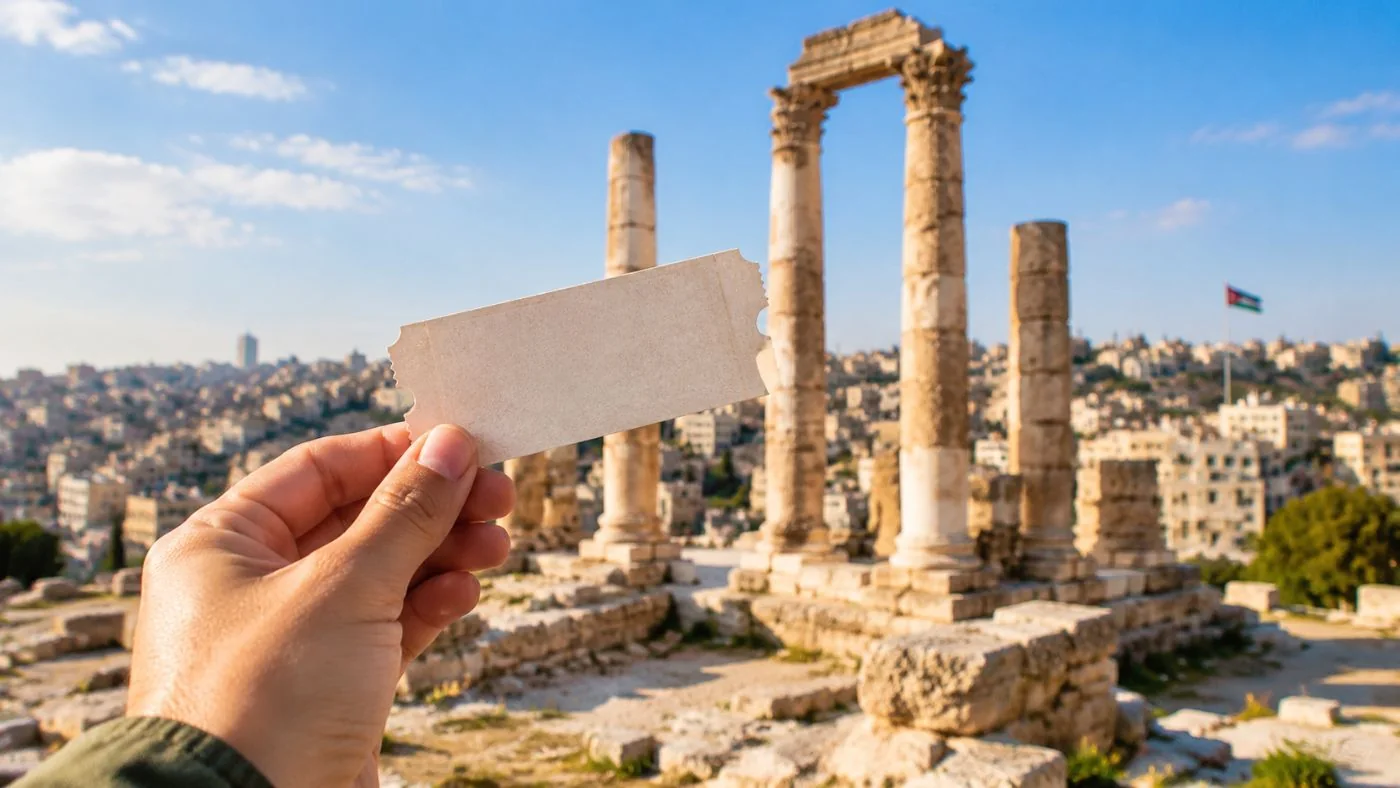
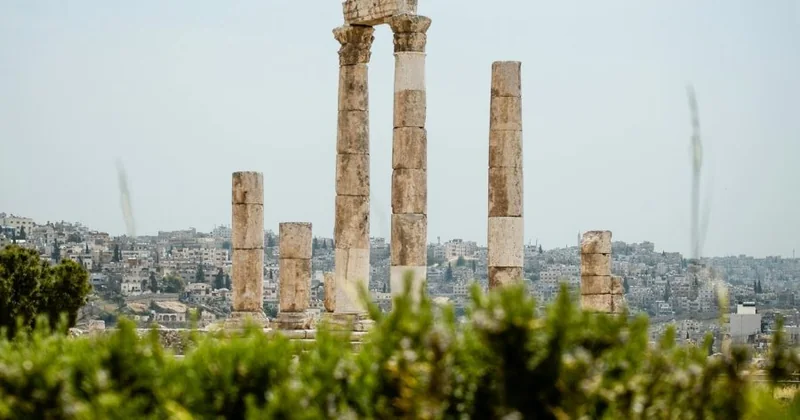
The great temple, usually called the Temple of Hercules, dated by inscription to AD 161-166, with a sacred precinct around it. Down in the valley they built the theatre, the Odeon and the Nymphaeum.
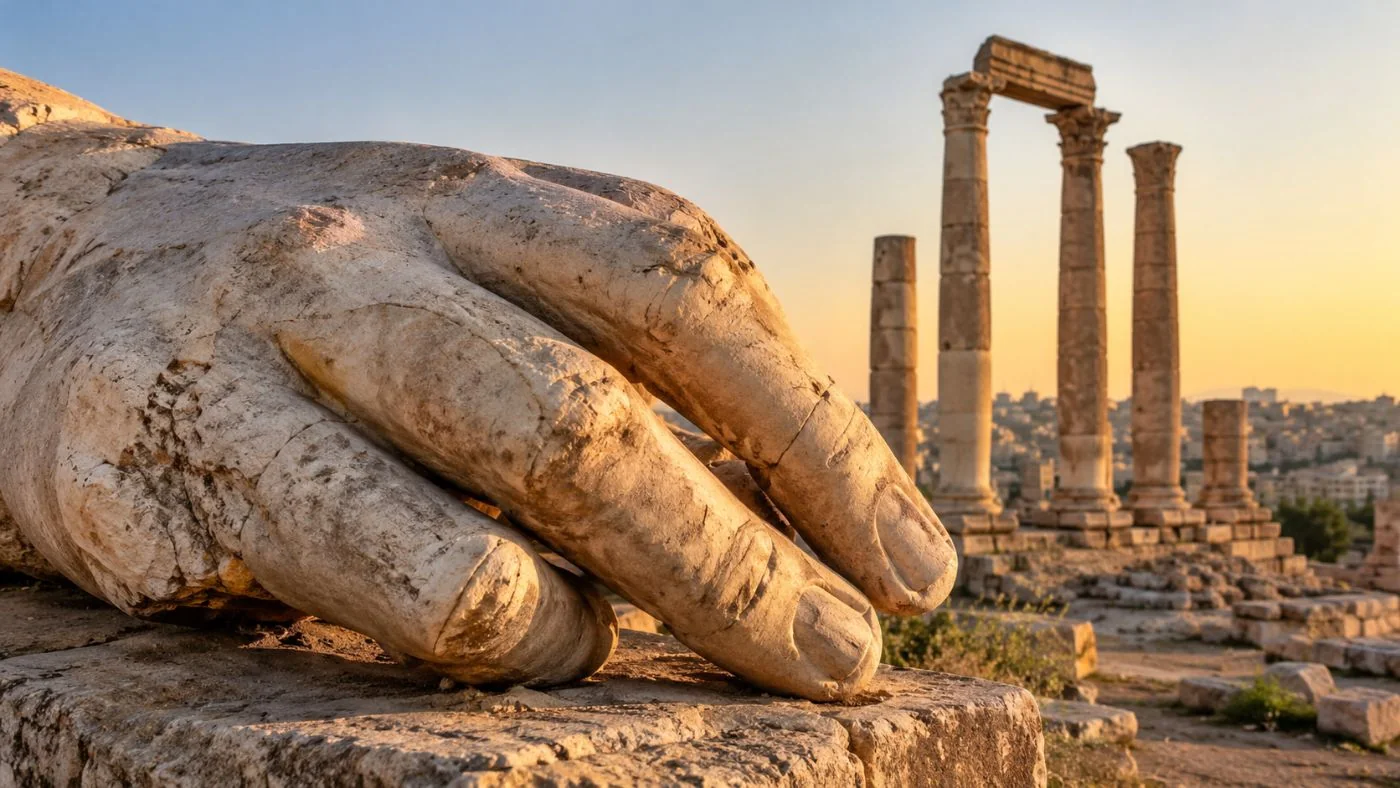
The temple was the showpiece: a podium 43 by 27 m, a portico of columns 13.5 m tall, and a statue about 13 m tall, of which a hand and an elbow survive. An inscription dates it to the governorship of Geminius Marcianus, at the start of Marcus Aurelius's reign. Its dedication to Hercules is the traditional view; some scholars argue for a different god, and one suggests the colossal statue was female. There may have been an Ammonite temple to the god Milkom beneath it.
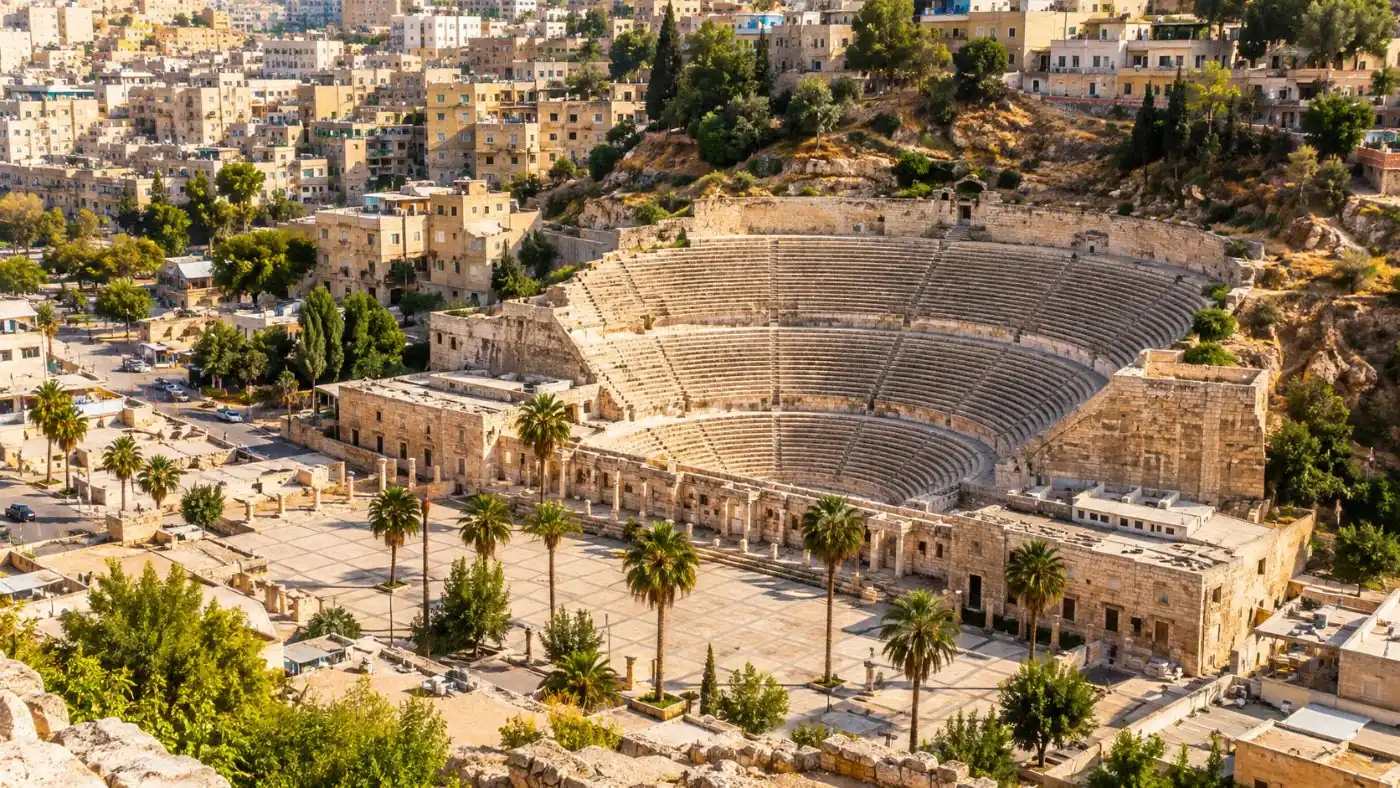
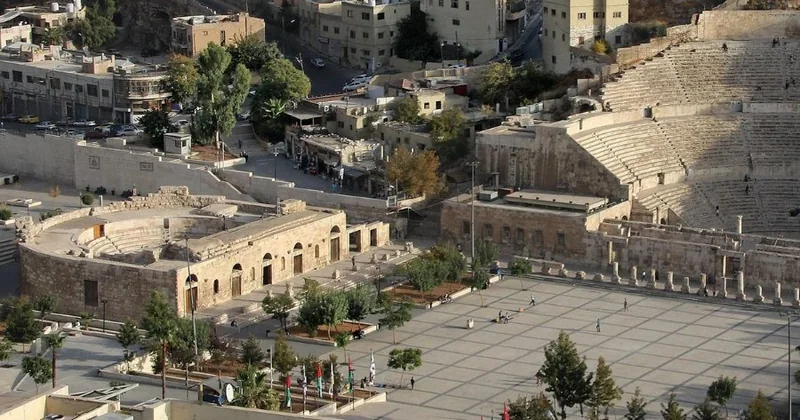
Below the hill, Roman Philadelphia's public buildings are still there. The 6,000-seat Roman Theatre dates to the reign of Antoninus Pius (138 to 161). The small Odeon next to it, about 400 seats according to the DoA, and the Nymphaeum, a fountain house with a 65 m façade further west, belong to the same century. Our guide to what to see covers the temple in detail.
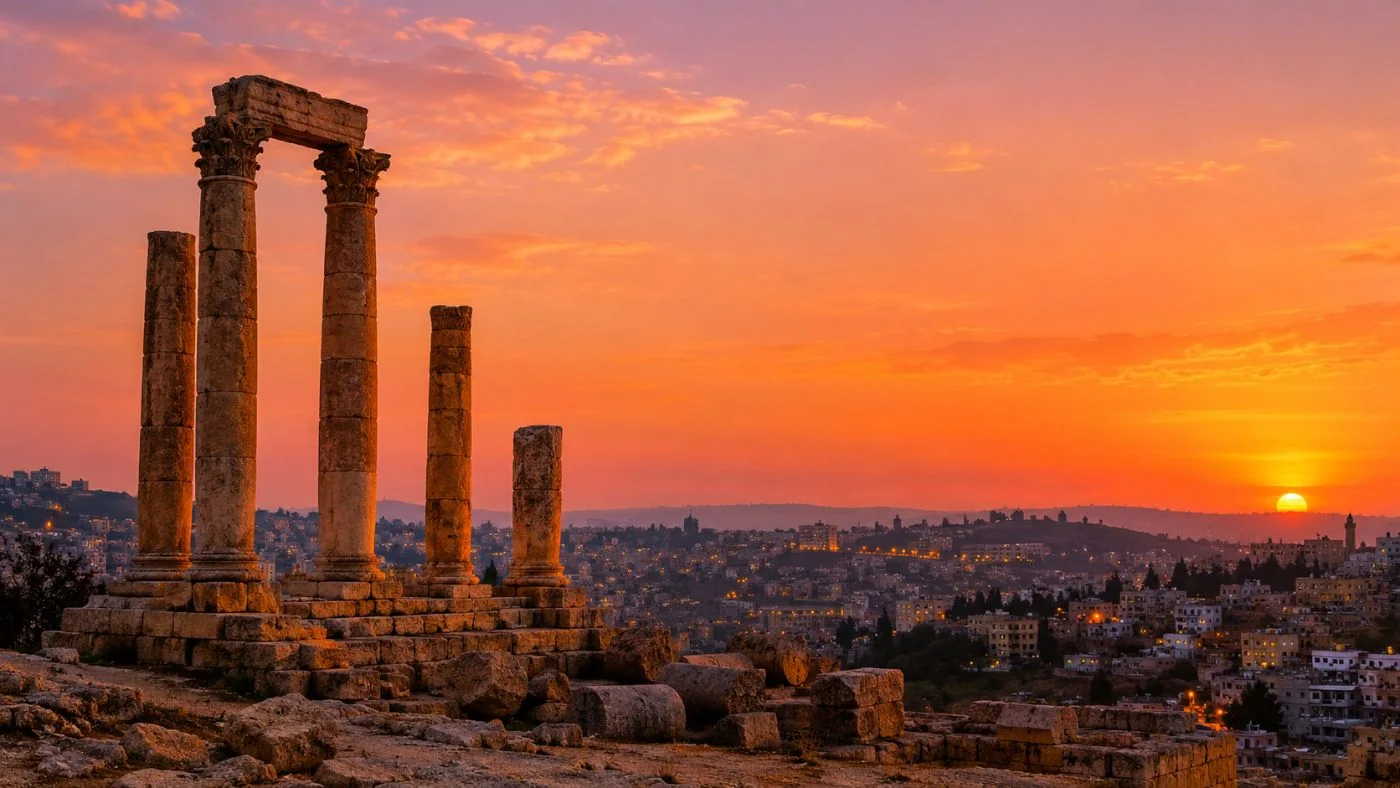
What happened under the Byzantines and the Umayyads?
Philadelphia became a Christian city with three churches on the hill. After 661 the Umayyads made it a governor's seat and built a palace, mosque and cistern there in the first half of the 8th century.
The DoA records three Byzantine churches on the Citadel. The one you can see, a basilica of around AD 550, reused columns and Corinthian capitals from the Roman temple. The plan of an earlier Byzantine building also survives under the Umayyad entrance hall, which copied its cross shape.
The Islamic conquest reached the region in the 630s, and under the Umayyad caliphs of Damascus the hill became the residence of the regional governor. The palace complex, probably built under Caliph Hisham (724 to 743), included the domed entrance hall, a colonnaded street, administrative buildings, the governor's residence and throne room, a bathhouse, a congregational mosque and the great cistern. Former DoA director general Fadi Balawi also points to military buildings and a mint (Jordan News). The decoration borrows from Persian palace art.
It did not last long. A massive earthquake in AD 749 brought much of the complex down, and a year later the Abbasid revolution swept the Umayyads away. The Abbasids moved the capital to Iraq, and the palace was split into smaller dwellings.
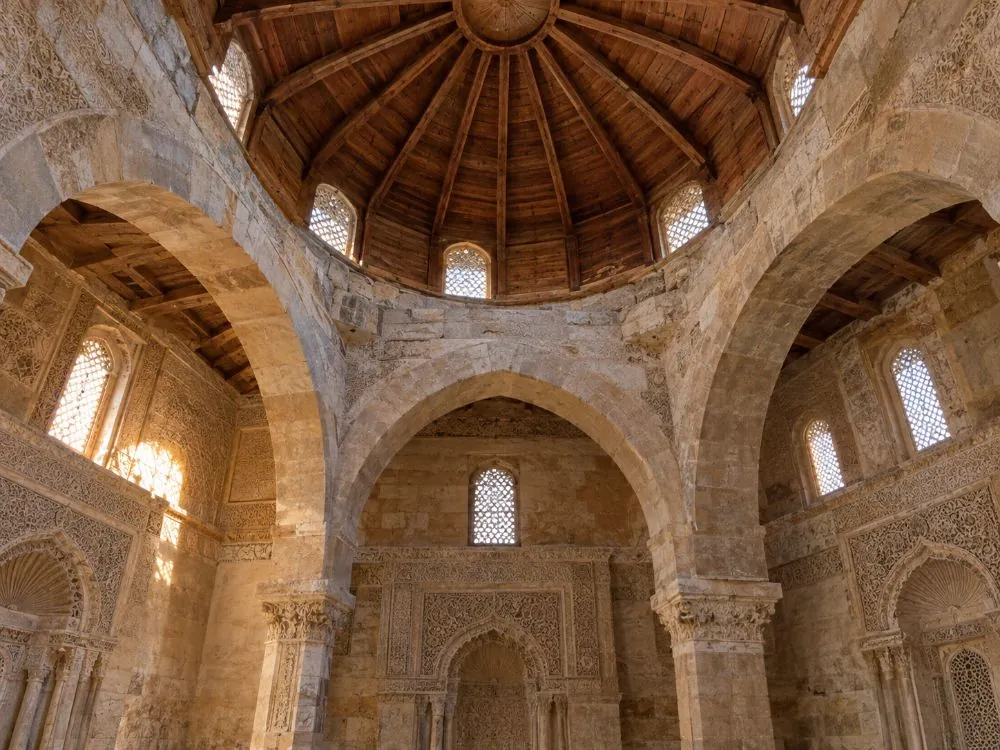
Walk from the Roman temple to the Umayyad palace with a local guide, then on to the theatre below.
Check dates for the Citadel and art trail walkWhat happened to the Citadel after the Umayyads?
A long decline. The hill shrank to a lookout post under the Ayyubids, who built a watchtower around 1220, then lay largely empty until Circassian settlers arrived in 1878.
Under the Abbasids (750 to 969) and the Fatimids (969 to 1071) the palace slowly decayed. In the Ayyubid period, Saladin's dynasty, a small guard tower went up on the south wall around 1220, built partly from the temple's stones. It was long thought to be a Crusader work. After the 13th century the Citadel lost its role, and travellers in later centuries found an empty ruin.
The British explorer Claude Conder surveyed the site in 1881, three years after the Circassians had moved into the valley below. Italian, British, French, Spanish and Jordanian teams worked on the hill through the 20th century. The Jordan Archaeological Museum opened on top in the early 1950s, the first museum in the country.
What is being restored and discovered now?
The temple columns were re-erected in 1990-93, the palace hall got its timber dome in the late 1990s, and German-Jordanian excavations on the Ammonite levels ran again in June 2026.
Most of what you see standing is the result of three projects. ACOR and the DoA excavated and partly rebuilt the temple between 1990 and 1993, lifting a 16-ton architrave back into place, and restored the Ayyubid tower in 1996. A Spanish mission, with the DoA, conserved the Umayyad palace from the mid-1990s and roofed the entrance hall with a reversible dome of laminated timber. The Amman Archaeological Project is now digging into the Iron Age.
Visitor numbers are rising fast: 48,252 in January and February 2026, up 57% on the year before. A cable car linking the hill with Jabal al-Weibdeh and the Roman Theatre is in preparation; see our cable car post.
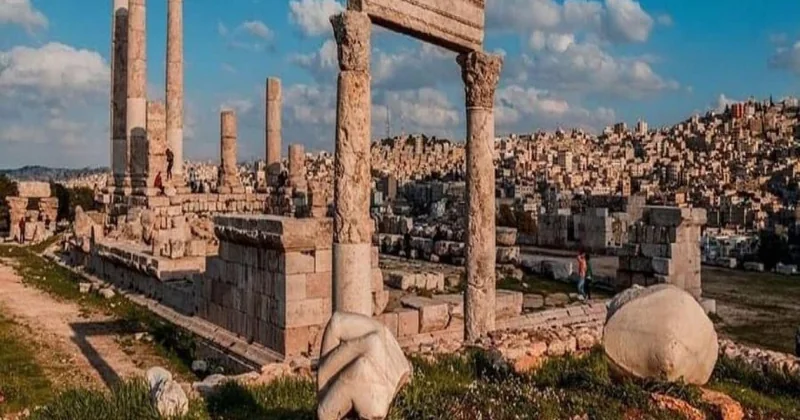
The Citadel and the Roman Theatre in the morning, Roman Jerash in the afternoon, with a private driver.
Explore the Amman and Jerash day trip Tour detailsFrequently asked questions
Who built the Amman Citadel?
No single builder. The Bronze Age walls came first, then the Ammonites, the Romans (the Temple of Hercules), the Byzantines (churches) and the Umayyads (the palace complex), with an Ayyubid watchtower around 1220.
What was Amman called in the past?
Rabbath Ammon in the Iron Age, Philadelphia from the 3rd century BC through the Roman and Byzantine periods, and Amman again after the Islamic conquest.
How old is the Amman Citadel?
The hill was fortified around 1800 BCE, in the Bronze Age. The standing monuments date from AD 161 (the temple) to around 1220 (the watchtower).
Is the Amman Citadel a UNESCO World Heritage Site?
No. It is not on the UNESCO list. Jordan's World Heritage Sites include Petra, Wadi Rum and Quseir Amra.
Ready to book
Choose your tour
Free cancellation up to 24 hours before on every option. Prices are from-prices in USD and move with the season.
Amman Citadel Guided Walking Tour
- A local guide for 90 minutes on the Citadel
- Temple of Hercules, Umayyad Palace and fortifications
- Guided in English or Arabic
Amman City & Jerash Private Day Trip
- Private air-conditioned car with an English-speaking driver
- Hotel pickup and drop-off in Amman
- About 1 hour at the Citadel and 2 hours in Jerash
Private Amman Tour: History, Food & Markets
- Private air-conditioned car from and to your hotel
- Local guide in English or Italian
- Citadel visit (self-guided) and the Roman Theatre